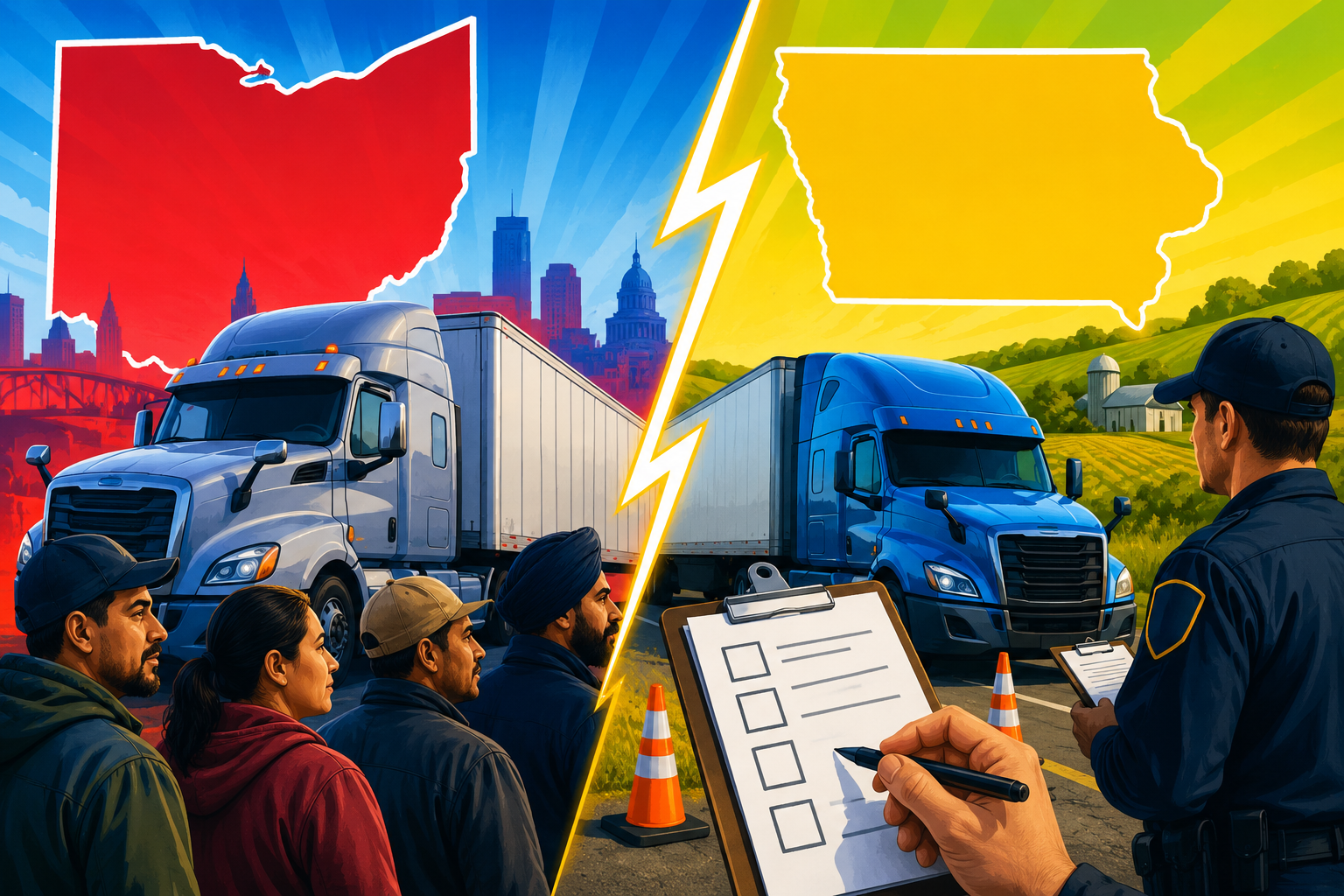
Two major changes are hitting the trucking industry — one in Ohio affecting thousands of immigrant drivers, and one in Iowa cracking down on English language requirements.
Ohio Cancels Licenses for Certain Foreign-Born Drivers
A non-domiciled CDL is a commercial driver’s license issued to someone who is legally allowed to live and work in the U.S. but is not a permanent resident. Ohio is now ending that program entirely.
The review affects commercial drivers who are not U.S. citizens or permanent residents but are legally authorized to work in the country. About 5,000 of them are being notified by mail.
Here’s what happens next: drivers will receive one of two letters. Those whose paperwork does not meet updated federal rules will get a “Notice of CDL Downgrade,” and their license will be reduced to a basic Class D passenger driver’s license 30 days after receiving that notice — meaning they can no longer legally drive a commercial truck.

Drivers who believe they have the right documents can request a hearing and submit additional paperwork to show they still qualify under federal rules. Those whose documents meet the new standards will receive a letter stating that their licenses remain valid until they expire.
Ohio stopped issuing or renewing non-domiciled CDLs in September 2025 when federal rules changed, and it does not plan to resume. The reverification process does not apply to the state’s roughly 406,000 regular CDL holders or to drivers who have permanent resident status.
One driver, Columbus truck driver Julio Soto, told a local TV station that repeated issues with BMV employees caused his CDL to expire, leaving him unable to work while he pursues U.S. citizenship.
Iowa Now Requires English Proficiency — and Fines Are Steep
Iowa has gone further than most states by making English-language proficiency a hard requirement for obtaining or retaining a commercial driver’s license.
Under Senate File 2426, CDL applicants must pass a computer-based English proficiency exam before receiving their license. The test only needs to be passed once, but can be retaken. Governor Kim Reynolds signed the bill into law on May 3rd.
The penalties are significant:
- Drivers caught operating a commercial truck without meeting English proficiency standards face a serious misdemeanor charge and a $1,000 civil penalty.
- Trucking companies that hire or contract with non-compliant drivers face a simple misdemeanor charge and a fine of $10,000 per violation, plus an “out of service” order that can prevent the company from operating in the state.
Supporters of the law pointed to deadly crashes as the reason for the push. Lawmakers cited multiple examples of fatal commercial vehicle accidents in states like Florida and California involving drivers who could not speak, read, or understand English.
Iowa’s law is one of the most aggressive English proficiency enforcement frameworks in the country, tying driver qualification directly to real-time consequences for carriers. It comes as federal enforcement has also ramped up — since June 2025, when the Commercial Vehicle Safety Alliance re-added English Language Proficiency violations to its out-of-service criteria, more than 17,000 ELP violations have been issued nationwide.