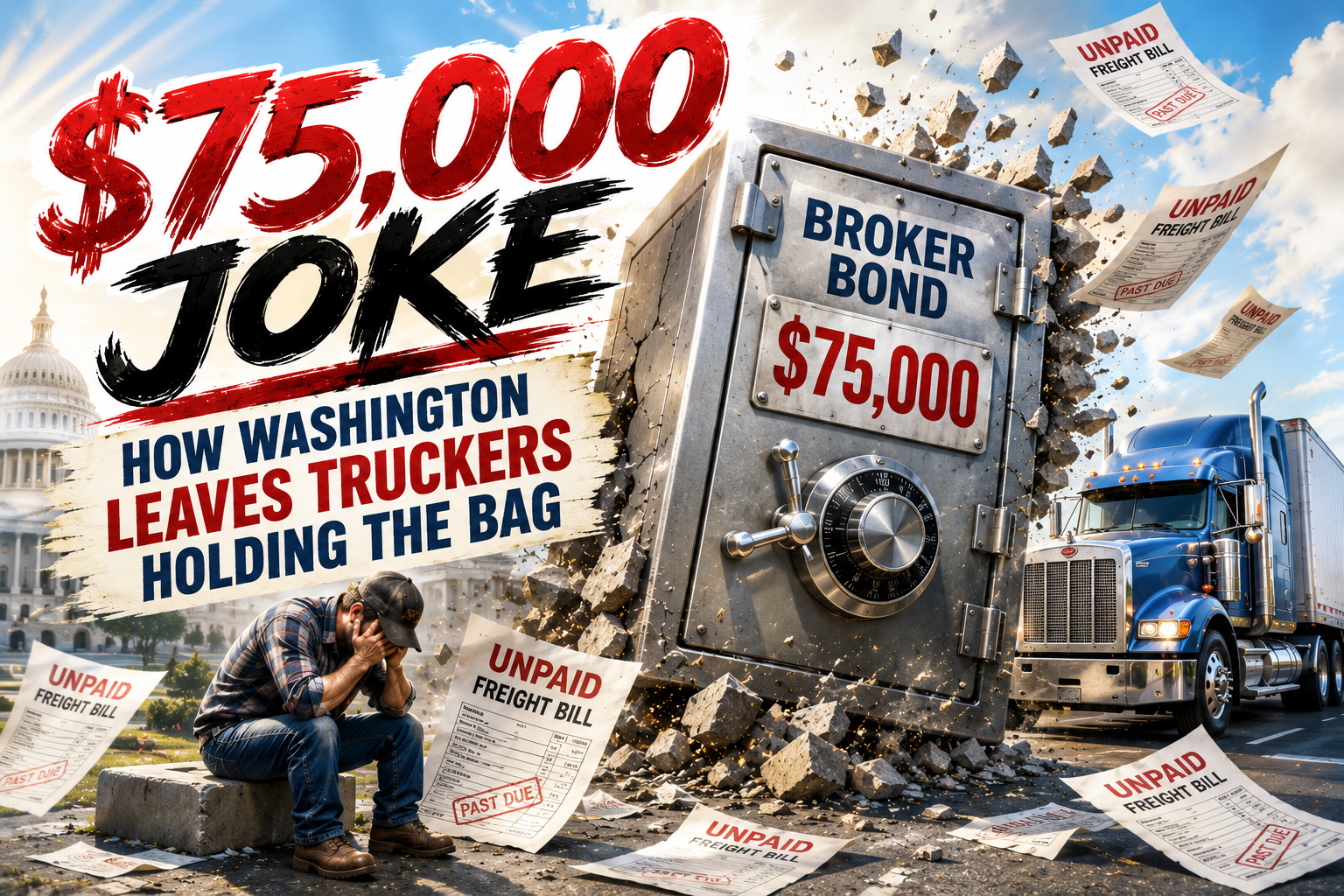
A freight broker can handle millions of dollars in freight, yet federal law still requires only $75,000 in financial security.
That should make every owner-operator and small fleet ask one question:
Who exactly is this $75,000 protecting?
The trucker finances the load before getting paid.
We provide the truck. We buy the diesel. We pay the driver. We carry the insurance. We pay the tolls. We maintain the equipment. We accept the highway liability.

Then we deliver the freight—and wait for our money.
If a broker suddenly shuts down owing 50 carriers $5,000 each, that’s $250,000 owed to truckers.
But only $75,000 in required financial security may stand between those carriers and a major loss.
Do the math.
Being told, “Don’t worry, the broker was bonded,” doesn’t mean much when dozens of trucking companies are fighting over the same limited pot of money.
The real problem is bigger than $75,000.
It makes no sense that a small broker handling a few million dollars and a large brokerage handling hundreds of millions can be subject to the same basic federal minimum.
Financial responsibility should follow financial exposure.
If you handle more freight and control more carrier payments, you should be required to carry more financial protection.
Create a tiered system.
A smaller broker might carry $75,000 or $150,000.

As freight volume and carrier-payment exposure increase, require $250,000, $500,000, $1 million, or more.
The exact numbers can be debated.
The principle cannot be debated: If you put millions of dollars of carrier money at risk, a $75,000 safety net is not enough.
And while Washington debates broker transparency, let’s remember something important:
Transparency can show us where the money went. It doesn’t put the money back into the trucker’s bank account.
Owner-operators need transparency, but they also need meaningful financial protection.
Washington regulates trucking companies from almost every direction—insurance, ELDs, drug testing, Clearinghouse, driver qualification files, maintenance, inspections, hours of service, and safety compliance.
One serious violation can put a truck or driver out of service.
So why shouldn’t the businesses controlling millions of dollars in freight payments face financial-responsibility requirements proportional to the risk they create?
This isn’t anti-broker.
Good brokers should support it.
Responsible brokers pay their carriers and shouldn’t have to compete against undercapitalized operators who can run up massive carrier payables and leave trucking companies holding the losses.
Truckers aren’t asking Washington to guarantee their profits.
They’re asking Washington to make sure that when federal law calls something “financial responsibility,” it actually means financial responsibility.

The carrier already delivered the freight.
The diesel is already burned.
The driver already did the work.
The customer already received the shipment.
The trucker shouldn’t be the last person standing in line hoping there is still money left.
A broker doing millions of dollars in business with only $75,000 in required financial security?
That’s the $75,000 joke.
Unfortunately, when a broker fails, the owner-operator is usually the punchline.
— Publisher’s Editorial
Punjabi Trucking USA