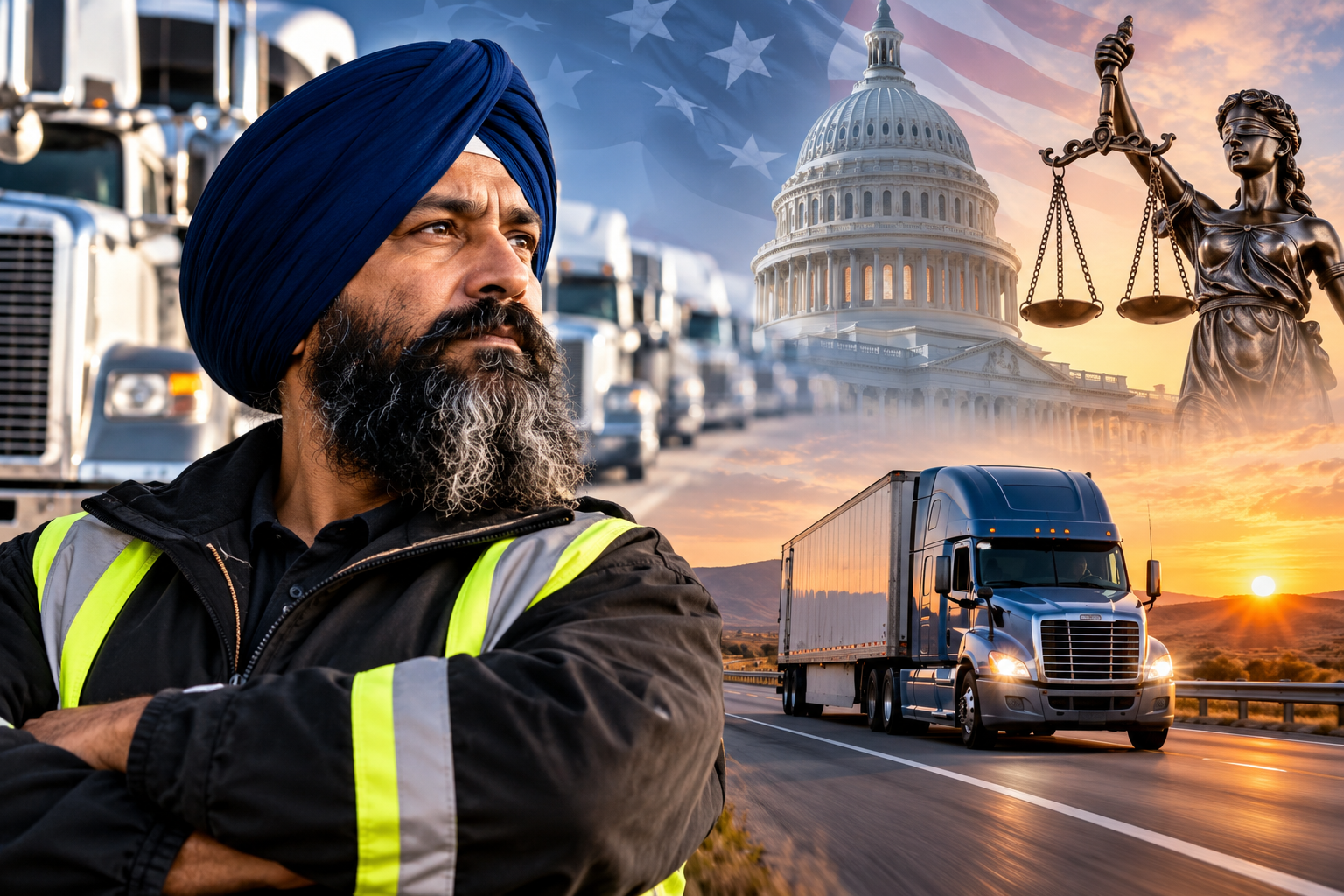
Supporters of stricter enforcement cite the Dalilah Coleman crash, while Sikh civil rights advocates warn against discrimination, and the American Trucking Associations call for standardized testing.
The Federal Motor Carrier Safety Administration’s (FMCSA) proposed English Language Proficiency (ELP) rule has sparked a heated national debate, bringing together trucking associations, highway safety advocates and Sikh civil rights organizations with sharply different perspectives on how English proficiency requirements should be enforced.
The controversy comes as thousands of public comments have been submitted in response to the proposal. Many supporters argue that stronger enforcement is necessary to improve highway safety, while critics question whether the government has established clear, objective standards for evaluating drivers.
At the center of the debate is a fundamental question: How can the federal government ensure commercial drivers meet English proficiency requirements without inconsistent enforcement or discrimination based on accents, ethnicity, or religion?

Sikh Coalition Raises Concerns About Discrimination
The Sikh Coalition, a national civil rights organization, has raised serious concerns about the proposed rule, warning that subjective roadside English assessments could disproportionately affect Sikh and other immigrant truck drivers.
The organization does not dispute that commercial drivers need sufficient English proficiency to understand traffic signs, communicate with law enforcement, and respond to safety-related instructions.
Instead, it questions whether roadside inspectors have adequate guidance to evaluate drivers consistently and fairly.
A driver who communicates effectively but speaks with a Punjabi accent should not be considered unqualified simply because an enforcement officer has difficulty understanding that accent.
The Coalition has also highlighted the potential consequences of placing drivers out of service without a transparent process for challenging incorrect assessments.
For independent owner-operators, an out-of-service order can mean lost revenue, missed deliveries, damaged customer relationships, and potentially serious financial hardship.
Controversial DHS Social Media Post Adds to Community Concerns
The debate has become particularly sensitive within the Sikh trucking community following a controversial Department of Homeland Security social media post targeting a driver identified as “Mr. Singh.”
The post, which was later removed, drew criticism for its language and the perception that it singled out Sikh drivers.
For many Sikh truck drivers and trucking business owners, the incident raised broader concerns about how government agencies communicate enforcement priorities.
The issue is not whether federal safety regulations should apply to Sikh drivers. They absolutely should, just as they apply to every other commercial driver.
The concern is whether enforcement and government messaging will treat drivers equally, regardless of their religious identity, appearance, or national origin.
American Trucking Associations Calls for Clearer Testing Guidelines
The American Trucking Associations (ATA) generally supports English proficiency requirements but has questioned the consistency of roadside assessments.
ATA has emphasized the need for clear, standardized evaluation procedures so that a driver’s qualification does not depend on which enforcement officer conducts an inspection.
One possible approach is to incorporate standardized English proficiency assessments into the CDL licensing and renewal process.
Such a system could help ensure that drivers are evaluated against consistent standards before they begin operating commercially.
This is an important point of overlap between ATA and the Sikh Coalition.
Although the organizations approach the issue from different perspectives, both recognize the importance of consistent and defensible testing standards.
Dalilah Coleman Crash Fuels Support for Stronger Enforcement
Supporters of the proposed regulation have repeatedly referenced the tragic California truck crash that seriously injured young Dalilah Coleman.
The incident has become a prominent part of the national discussion surrounding commercial driver qualifications, highway safety, and immigration-related licensing concerns.
Many public comments argue that stronger enforcement of English proficiency is necessary to prevent similar tragedies.
However, a critical distinction must be made between supporting highway safety and establishing whether a particular regulatory change would have prevented a specific crash.
Investigations must determine the actual contributing factors, including driver qualifications, training, licensing practices, vehicle operation, and other relevant circumstances.
Safety regulations should be evidence-based and designed to address identifiable risks.
The suffering of crash victims and their families deserves recognition, but tragedies should not become justification for broad assumptions about entire communities of commercial drivers.
OOIDA Supports Tougher Enforcement
The Owner-Operator Independent Drivers Association (OOIDA) has strongly supported the proposed changes.
OOIDA argues that English proficiency enforcement weakened significantly over the past decade, allowing some drivers who failed to meet federal requirements to continue operating commercial vehicles.
According to figures cited by OOIDA, roadside English proficiency violations declined from more than 100,000 in 2014 to approximately 9,700 in 2024.
The association believes consistent enforcement is essential to protecting qualified drivers and improving public safety.
However, changes in enforcement totals do not independently establish the number of unqualified drivers or prove that language deficiencies caused specific crashes.
FreightWaves

What Does the Proposed FMCSA Rule Change?
Federal regulation 49 CFR §391.11(b)(2) already requires interstate commercial drivers to possess sufficient English proficiency to communicate with the public, understand highway signs and signals, respond to official inquiries, and complete required reports.
FMCSA’s August 2026 proposal seeks to formally establish out-of-service consequences for violations within the federal regulatory framework, consistent with the Commercial Vehicle Safety Alliance’s enforcement criteria.
The proposed rule includes a limited exception for certain commercial operations near the U.S.–Mexico border.
The public comment period closed October 9, 2026. As of October 15, FMCSA has not finalized this particular rulemaking. Existing English proficiency requirements and roadside enforcement policies continue to apply.
Punjabi Trucking USA Editorial: Safety Should Never Become an Excuse for Discrimination
English proficiency is a legitimate requirement for commercial truck drivers. Every driver must understand critical highway signs, communicate with enforcement personnel, and respond appropriately during emergencies.
However, speaking English with a Punjabi accent does not make a driver unsafe.
A significant difference exists between a driver who cannot understand basic safety instructions and a driver who speaks English differently from a native-born American.
The federal government must recognize that distinction.
If FMCSA intends to strengthen English proficiency enforcement, it should establish clear national testing standards, train enforcement officers consistently, and provide a meaningful process for drivers to challenge questionable out-of-service determinations.
The fact that ATA and the Sikh Coalition both raise concerns about subjective testing deserves serious attention.
Their agreement on this issue demonstrates that standardized testing is not simply a civil rights concern. It is also a matter of regulatory consistency, professional driver qualifications, and fair treatment.
Trucking companies should not have to guess whether a driver who passes an English assessment in California will pass the same assessment in Texas, Arizona, or Wyoming.
Likewise, a qualified driver should not risk losing a day’s income because two enforcement officers interpret the same conversation differently.
Highway safety and equal treatment are not competing priorities. Both are necessary for an effective regulatory system.

What Happens Next?
FMCSA will review the public comments before determining whether to finalize the proposed rule or make changes.
The debate now centers on three major questions: whether existing roadside assessments are sufficiently objective, whether English proficiency should be tested more consistently during CDL issuance and renewal, and how to protect drivers from discriminatory or incorrect enforcement decisions.
For the Punjabi trucking community, the outcome could influence driver recruitment, qualification procedures, roadside inspections, and the livelihoods of thousands of drivers and owner-operators.
The industry deserves regulations that identify genuine safety risks while treating every qualified commercial driver fairly and with respect.
Punjabi Trucking USA believes that strong safety standards and fair enforcement must go hand in hand. The goal should be safer highways—not selective enforcement.