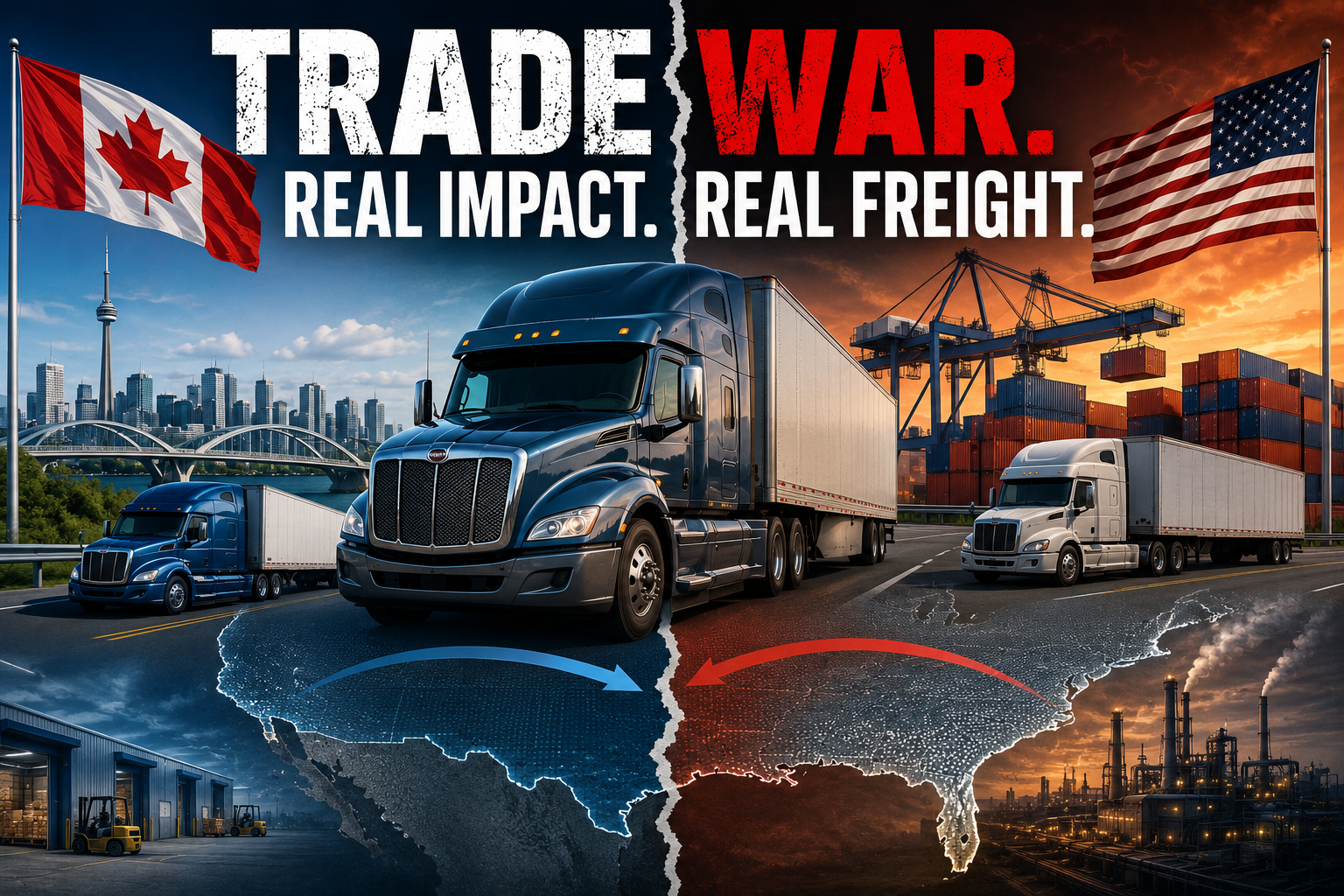
New U.S. tariffs and Canadian retaliation threaten freight volumes, cross-border rates, manufacturing supply chains, and the economics of thousands of carriers operating between the two countries. The automotive sector is particularly exposed because vehicles and components routinely cross the border during production, and the U.S. has now announced a 50% tariff on certain Canadian products as pressure on Canadian vehicles, parts and trucks intensifies.

For trucking companies, the biggest concern is not the tariff itself—it is what happens to freight afterward. When tariffs make products more expensive, manufacturers may reduce orders, change suppliers, relocate production or source domestically. Each of those decisions can eliminate existing truckloads and permanently change established freight lanes.
Cross-border carriers could also face serious equipment imbalances. If fewer Canadian loads travel south, fewer trucks will be positioned in the United States for northbound freight. This could create an unusual situation where overall freight volumes decline while rates rise sharply in one direction. Carriers therefore need to watch empty miles, total revenue per mile, and freight volume—not simply spot rates.
The longer-term implications could be even greater. Canada may accelerate efforts to reduce its dependence on the U.S. market, while American companies may move more manufacturing and sourcing into the United States. That could shift freight from traditional Canada–U.S. lanes toward domestic Canadian and domestic U.S. transportation, while potentially increasing opportunities around ports, warehouses, transloading and regional distribution.
Small and midsize carriers are especially vulnerable if they depend heavily on one border corridor, customer, or industry such as automotive, steel, lumber, or agriculture. Punjabi-owned fleets should begin measuring their “tariff exposure” by identifying how much revenue depends on cross-border freight and which industries ultimately generate those loads.
Canada’s latest response illustrates how quickly the situation is developing: on August 25, Ottawa announced matching countermeasures against U.S. goods after the new U.S. tariffs took effect August 22.
The central question for trucking is no longer simply whether tariffs will increase costs. It is: Where will the freight move next?
The carriers that diversify customers, understand their industry’s tariff exposure, reduce empty miles, and identify new domestic and logistics opportunities could emerge stronger. Those that depend entirely on traditional cross-border lanes could face a much more difficult future.
Bottom line: Truckers don’t haul tariffs—they haul the economic decisions created by tariffs. When manufacturers change suppliers, factories, or markets, the freight moves with them.