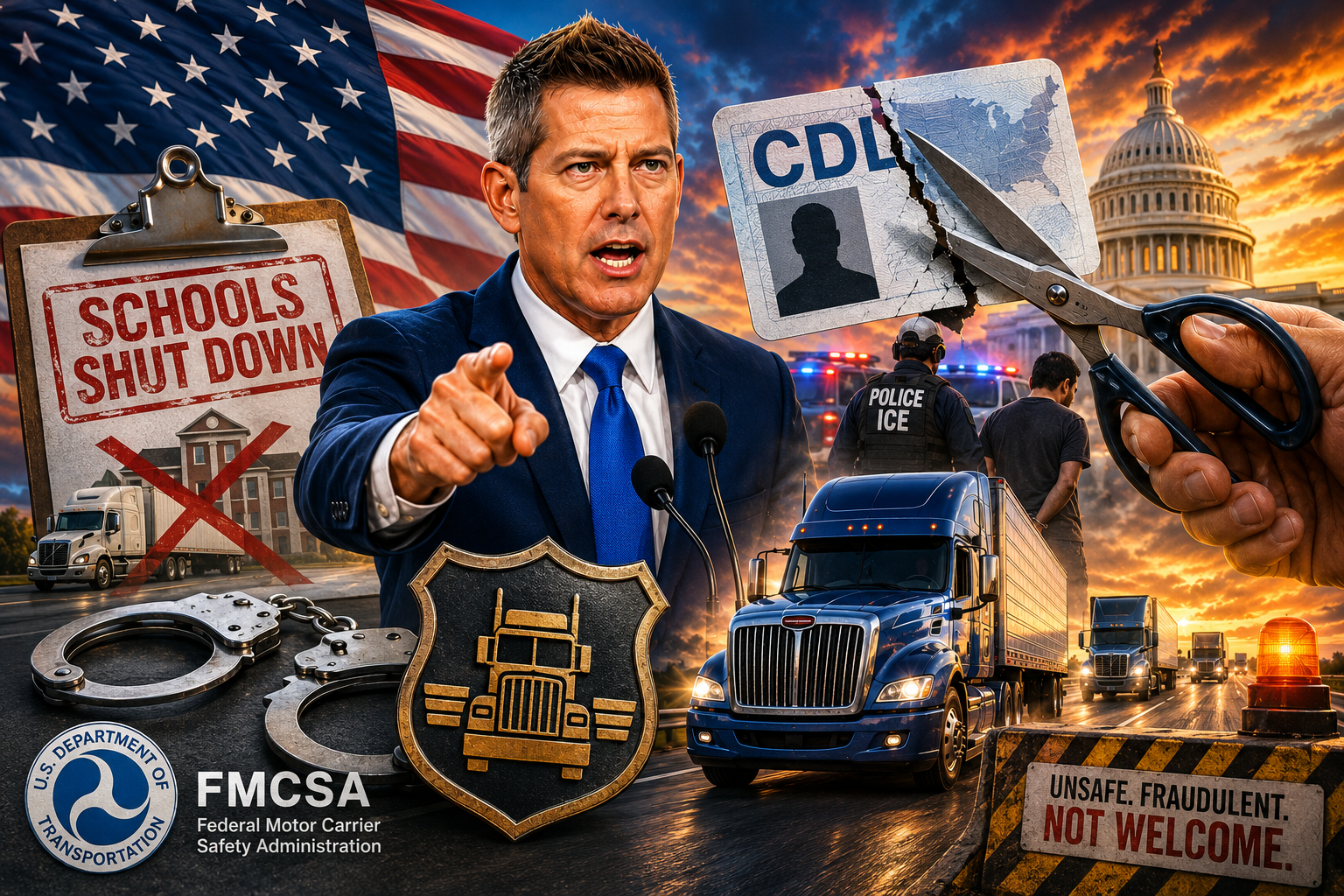
In a single week this summer, the federal government shut down 110 truck driving schools by emergency order, arrested 95 illegally present truck drivers in an Arizona border sweep, and reopened a decade-old fight over whether America actually has a shortage of truck drivers at all. Together, these events mark the most aggressive federal intervention into commercial trucking in years — and they’ve split an industry that usually agrees on very little into two camps that agree on even less.

What Actually Happened
At a press conference in Detroit, Transportation Secretary Sean Duffy, flanked by Homeland Security Secretary Markwayne Mullin and FMCSA Administrator Derek Barrs, announced the emergency removal of 110 commercial driver training schools from the federal registry. Another 160-plus schools were pulled for operating without basic infrastructure — no trucks, no driving yards, no classrooms. Collectively, the shuttered schools are linked to more than 5,000 drivers later cited for failing federal English-proficiency requirements, and to 239 fatal crashes.
Two schools were named specifically as examples. A California school had certified 36 drivers later cited for English violations, one of whom was involved in a fatal Oklahoma crash. A Texas school had certified 58 such drivers, one of whom ran a stop sign and killed a pedestrian. Homeland Security Investigations ran a parallel sweep covering more than 200 schools across 23 states, and the Justice Department stood up a new task force targeting trucking fraud in the industrial Midwest.
The geographic data, released the following day, showed the crackdown concentrated in five states — Texas and Pennsylvania with 13 affected schools each, California with 11, Florida with 10, and Utah with 9 — accounting for roughly two-thirds of all physical-location schools identified. Notably, the list splits nearly evenly between Republican- and Democratic-leaning states, which officials cited as evidence the effort wasn’t partisan.
Days earlier and separately, Border Patrol’s Yuma Sector had conducted a five-day operation in Arizona, arresting 143 people from 18 countries. Ninety-five of them were truck drivers living in the country illegally, each holding a valid state-issued CDL — 76 from California, six from New York, the rest scattered across other states. The same operation disrupted two human-smuggling events and seized a firearm along with significant quantities of methamphetamine and marijuana, though officials did not connect the drug and smuggling arrests to the CDL holders specifically.
The Line That Cuts Both Ways
Addressing people who obtained CDLs fraudulently, Duffy delivered the crackdown’s most quotable moment: cut up the license and find something else to do, get off the road. It’s a hard line, and it’s been read two very different ways depending on the audience. Supporters hear it as accountability finally landing on an industry that’s tolerated fraud for years. Critics hear it as rhetoric that doesn’t distinguish cleanly enough between fraudulent operators and the much larger population of non-domiciled drivers who followed every rule.
That distinction matters, because Duffy himself has drawn it elsewhere, saying the problems are concentrated in a subset of non-domiciled CDLs rather than the category as a whole. Whether that nuance survives contact with a policy that’s on track to remove roughly 200,000 non-domiciled CDL holders from the industry is a fair question, and one the trucking world is watching closely.

The Fight Nobody Expected: Is There Even a Shortage?
The more surprising development may be Duffy’s open challenge to trucking’s oldest talking point: the driver shortage. For decades, the American Trucking Associations has argued the industry faces a persistent shortfall of qualified drivers, a claim used to justify everything from recruitment subsidies to looser entry standards. Duffy has now said plainly that he doesn’t buy it, and that anyone claiming otherwise should make the case.
He’s not alone. The Owner-Operator Independent Drivers Association, which represents independent truckers, has argued for years that the shortage was largely manufactured to justify cheap labor and to paper over an industry with brutal turnover — some large carriers see annual driver turnover exceeding 90 percent. That number, the argument goes, describes less a labor shortage than a retention failure: raise pay and improve working conditions, and drivers show up. Even ATA’s own chief economist has recently softened the association’s position, describing the issue as more about driver quality and safety records than a raw shortfall in bodies.
The counterargument hasn’t disappeared, though. Critics like the Niskanen Center have characterized the broader crackdown as an immigration enforcement effort wearing a safety label, warning that pulling roughly 200,000 legally authorized non-domiciled drivers from the workforce in a compressed timeframe will strain freight capacity in specific lanes and regions, regardless of whether a nationwide shortage exists in the aggregate. An aging driver population and the unglamorous realities of long-haul life—time away from home, irregular schedules—remain real constraints that a turnover argument doesn’t fully address.
Both things can be true at once: an industry with a genuine retention problem and specific regional or route-level capacity gaps that a fast regulatory change could make sharply worse before market adjustments catch up.

Reading the Whole Picture
None of these threads exist in isolation. The school shutdowns address a real and long-documented problem — fraudulent training operations, the so-called “24-hour CDL,” have been flagged by regulators for years. On that narrow point, there’s little serious argument against tighter oversight. But the speed and sweep of the broader campaign, layered onto an aggressive rollback of non-domiciled CDL eligibility and a public relitigating of the shortage narrative, makes this less a single safety initiative than a fundamental renegotiation of who gets to drive a truck in America and under what terms.
Whether that renegotiation improves highway safety without disrupting freight capacity, or does the opposite, is likely to be argued over for a long time — and unlike the school-fraud numbers, it isn’t the kind of question a press conference can settle.